Step away from the hotel buffet and dive into the colorful, chaotic, and utterly delicious world of Javanese dining spots.
1. The Everyday Fuel Stations: Warung & Warteg
The Classic Warung: The Javanese Cornerstone
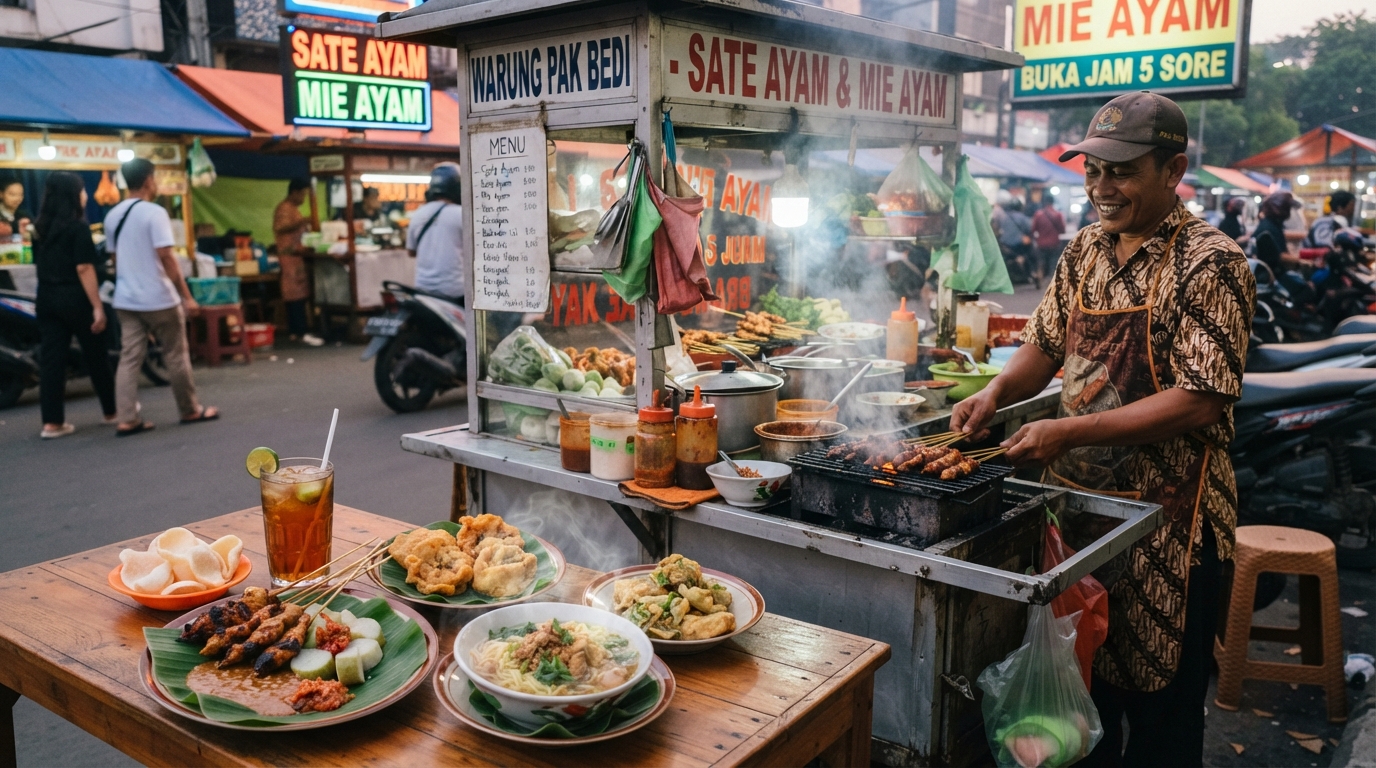
Mention the word warung to anyone who has spent a day traveling through Java, and a wave of nostalgia will follow. A warung is any small, locally owned, independent establishment—ranging from a modest wooden shack under a blue plastic tarp on a village roadside to a permanent open-air storefront in downtown Bandung, Jakarta, or Surabaya.
The Vibe: Utterly unpretentious, lively, and deeply communal.
What you’ll find: Home-style local comfort food, morning ginger tea, or a plate of fried noodles (*mie goreng*) cooked with a heavy dose of soul. You pull up a plastic stool, eat shoulder-to-shoulder with locals, and pay a few pocket-change bills when you are done.
The Legendary Warteg (Warung Tegal): The Working Man’s Cafeteria
If the standard warung is a general term, Warteg is an institution deeply woven into Javanese urban life. Originally pioneered by culinary migrants from Tegal in Central Java, these spots are scattered across every major street corner, railway station approach, and bus terminal on the island.
How it works: You walk in, grab a plate of steamed rice (nasi putih), and step up to a glowing glass-fronted cabinet stacked high with dozens of small metal trays. You simply point and plate (pilih-pilih): a scoop of crispy fried chicken (ayam goreng), a spoonful of spicy beef rendang, hard-boiled eggs in red chili paste (balado), potato fritters (perkedel), and stir-fried water spinach (kangkung).
Why it rules: It is lightning-fast, open late (often 24/7), dirt-cheap, and offers an infinitely customizable mountain of home-cooked goodness on a single plate.
2. Street-Side & Market Magic: Warkop, Angkringan, and Jajanan
Warkop (Warung Kopi): Midnight Havens
By day, a Javanese warkop is a humble neighborhood coffee stall brewing robust local brews like kopi tubruk. By night, it transforms into a vibrant social sanctuary. While you can get coffee, a warkop is universally famous across Java as the holy site for late-night Indomie worship—where noodles are custom-upgraded with raw eggs, corned beef, melted cheese, and a fistful of bird’s-eye chilis.
Angkringan: Intimate Carts Under the Stars
Commonly found glowing under yellow bulbs on the sidewalks of Yogyakarta, Solo, and Central Java, an angkringan is a small wooden pushcart covered by a colorful tarpaulin.
The Experience: Diners sit tightly packed together on low stools (*lempengan*) right beside the cart. You pick up small banana-leaf parcels of rice with tiny anchovy or sambal fillings (*Nasi Kucing*—"cat rice") and grab skewers of quail eggs (*sate puyuh*), grilled chicken intestines, and crispy tempeh warmed over a mini charcoal stove. It is cheap, cozy, and intensely social.
Jajanan Pasar: The Colorful World of Traditional Market Snacks
If meals are for fueling up, jajanan (market snacks) are for pure joy. Traditionally hunted down in Javanese morning markets (pasar tradisional) between 6:00 AM and 9:00 AM, these treats are a feast for the eyes and the sweet tooth:
Klepon: Vibrant green glutinous rice balls dusted in grated coconut that burst with warm, liquid palm sugar in your mouth (a Javanese market staple).
Gorengan: The undisputed king of Javanese savory street snacks—deep-fried tofu stuffed with veggies (tahu isi), banana fritters (pisang goreng), and vegetable fritters (bakwan), eaten piping hot with raw green chilis.
Dadar Gulung: Soft pandan crepes rolled up with sweet, caramelized coconut flakes.
3. Immersive & Cultural Feasts: Lesehan and Rumah Makan
Lesehan: Dining Close to the Earth
Want to instantly slow down your mealtime in Java? Find a lesehan spot. Instead of sitting on chairs at a table, diners sit cross-legged on woven bamboo mats (*leseh*) spread across the floor or on elevated wooden platforms, often lit by paper lanterns.
Where to find it: Beachside seafood shacks along Java's southern coast, traditional Javanese dinner tents, or lining Yogyakarta’s famous Malioboro street at night.
The Vibe: Incredibly relaxed and communal. Long low tables are stacked with shared platters of fried chicken, fresh raw vegetable herbs (*lalapan*), and blazing hot bowls of sambal. Crucial rule: Slip off your shoes before stepping onto the mat!
Rumah Makan / Restoran (Standard Restaurants)
What it is: Traditional brick-and-mortar restaurants serving refined regional Javanese dishes (or cross-archipelagic cuisines) in enclosed, comfortable, often air-conditioned spaces.
The Vibe: Perfect for large family gatherings, holiday meetups, and celebrating milestones with a massive spread of shared dishes, steamed rice, and claypot soups.
Pro-Tip for Your Javanese Culinary Journey:
Never be afraid to wander off the main tourist drag. If you see a humble warteg packed tight with office workers or a little angkringan cart surrounded by locals laughing under a flickering bulb in Central or East Java, pull up a stool. In Java, the best walls have peeling paint, the best snacks cost less than a dollar, and the kitchen door is always open to a curious traveler.